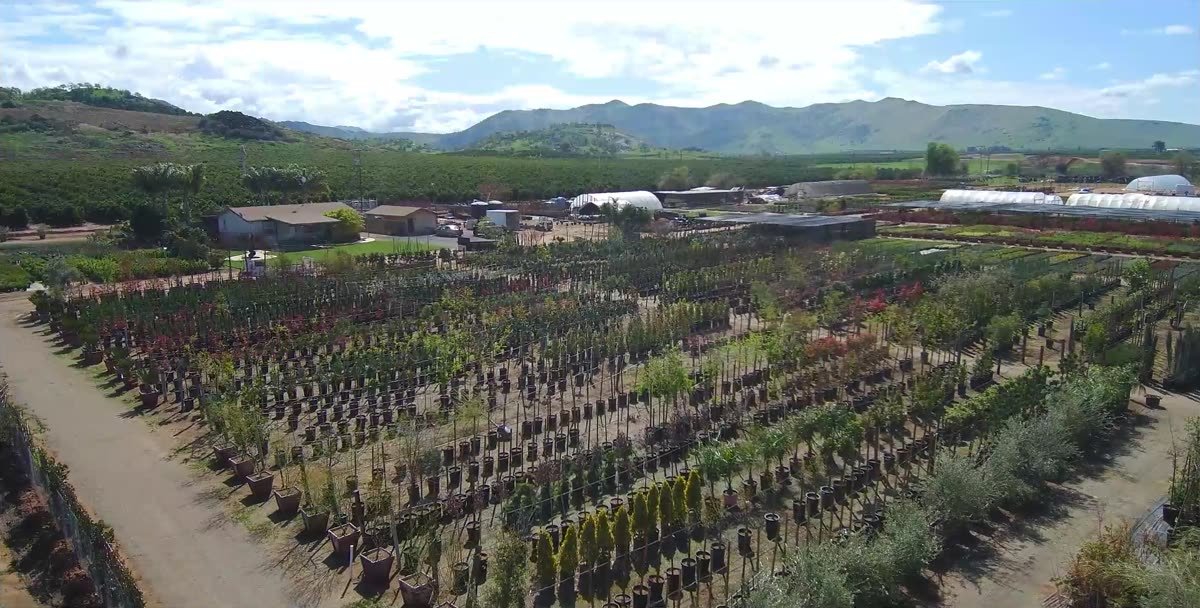
Retail & wholesale · Delivery available Mon–Fri
Home
Fresno Favorites All Fresno Favorites Trees Shrubs Perennials
Plants All Plants Trees Japanese Maples Shrubs Roses Tropicals Waterwise Palms Annuals Perennials Vines Fruit Trees/Citrus Shade Loving Topiaries Houseplants Groundcover
Products All Products Bulk Materials Pottery / Fountains / Statuary Irrigation Supplies Fertilizers / Chemicals Bagged Soils
Blog Contact About Call (559) 291-8733
Fresno Favorites

Trees

Five trees we've watched come through Valley summer after Valley summer — chosen for shade, seasonal colour and the kind of structure a yard is still glad of in twenty years.

Start here

Choose for the space first, the looks second.

Nearly every tree problem we're asked about traces back to one decision: a tree that was right for the pot but wrong for the spot. A Chinese Elm planted six feet from a foundation is a beautiful tree in a terrible place, and no amount of pruning fixes it later.

So measure first. Look up for power lines, out to the fence and house, and down for the sewer lateral. Then pick from the sizes below — every one of these five is proven here, so it's genuinely a question of scale and season, not survival.

SmallOklahoma Redbud — 15–20 ft, fits a front yard or courtyard
MediumCrape Myrtle — 15–25 ft, summer flower and winter bark
EvergreenFruitless Olive — 25–30 ft, silver structure all year
LargePistache & Chinese Elm — 30–50 ft of real canopy shade
The five

Our Fresno Favorite trees

Mature sizes are what to plan for at roughly ten to fifteen years in Valley conditions — not nursery-tag optimism.

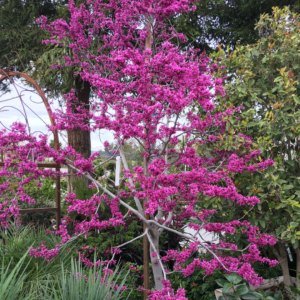
Oklahoma Redbud (Cercis reniformis 'Oklahoma') at Green Hills Nursery
Fresno Favorite

Oklahoma Redbud

Cercis reniformis 'Oklahoma'

A small tree that fits a real Fresno front yard. Blooms on bare wood before anything else wakes up, then holds thick, glossy leaves that resist scorching far better than eastern redbuds.

Mature size
15–20 ft tall × 15–20 ft wide
Sun
Full sun to part shade
Water
Moderate; low once established
Foliage
Deciduous
Bloom / interest
Wine-red flowers, early spring (before leaves)

From our staff: Give it afternoon shade in the hottest western exposures. Prune only to shape, right after flowering.
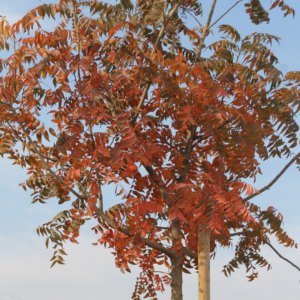
Chinese Pistache (Pistacia chinensis) at Green Hills Nursery
Fresno Favorite

Chinese Pistache

Pistacia chinensis

Arguably the best fall color in the Central Valley, and genuinely tough — it shrugs off heat, alkaline soil and drought once its roots are down.

Mature size
30–40 ft tall × 25–35 ft wide
Sun
Full sun
Water
Low once established
Foliage
Deciduous
Bloom / interest
Grown for foliage; brilliant orange-red fall color

From our staff: Young trees can look gawky and lean; stake and structurally prune the first few years and it matures into a broad, even canopy. Plant male ('Keith Davey') selections to avoid fruit litter.

Photo coming soon
Fresno Favorite

Chinese Elm

Ulmus parvifolia

Fast shade when you need it yesterday, with beautiful patchwork bark that peels to cream, orange and grey. Handles reflected heat off driveways and walls.

Mature size
40–50 ft tall × 40–50 ft wide
Sun
Full sun
Water
Moderate
Foliage
Semi-evergreen in mild winters
Bloom / interest
Inconspicuous; grown for shade and mottled bark

From our staff: The speed is the catch — prune for structure early and often, or it develops weak, narrow branch crotches that split in wind.

Photo coming soon
Fresno Favorite

Fruitless Olive

Olea europaea 'Swan Hill' / 'Wilsonii'

Silver-grey evergreen structure that looks intentional year-round and asks for almost no water. The Mediterranean climate match is close to exact.

Mature size
25–30 ft tall × 25–30 ft wide
Sun
Full sun
Water
Very low once established
Foliage
Evergreen
Bloom / interest
Fruitless selections; no messy drop

From our staff: 'Swan Hill' is the one to ask for if allergies are a concern — it produces little to no pollen. Avoid overwatering; wet feet is the main way these fail here.

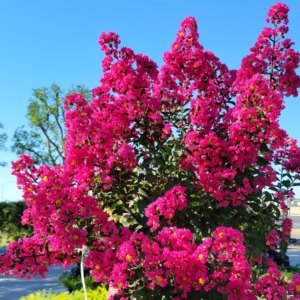
Crape Myrtle (Lagerstroemia indica & hybrids) at Green Hills Nursery
Fresno Favorite

Crape Myrtle

Lagerstroemia indica & hybrids

Blooms through the hottest stretch of a Fresno summer, when almost nothing else does, then follows with fall color and sculptural winter bark.

Mature size
15–25 ft tall × 10–20 ft wide (variety dependent)
Sun
Full sun
Water
Low to moderate
Foliage
Deciduous
Bloom / interest
Heavy summer bloom — white, pink, red or lavender — often 60–100 days

From our staff: Ask for mildew-resistant hybrids ('Natchez', 'Muskogee', 'Tuscarora'). Never 'crape murder' — topping ruins the branch structure and produces weak, whippy regrowth.

Side by side

Quick comparison

Useful when the deciding factor is height or water rather than looks.

Tree Mature heightSun WaterFoliage
Oklahoma RedbudCercis reniformis 'Oklahoma' 15–20 ftFull sun to part shadeModerate; low once establishedDeciduous
Chinese PistachePistacia chinensis 30–40 ftFull sunLow once establishedDeciduous
Chinese ElmUlmus parvifolia 40–50 ftFull sunModerateSemi-evergreen in mild winters
Fruitless OliveOlea europaea 'Swan Hill' / 'Wilsonii' 25–30 ftFull sunVery low once establishedEvergreen
Crape MyrtleLagerstroemia indica & hybrids 15–25 ftFull sunLow to moderateDeciduous
Getting them established

Planting & care for Valley trees

Trees are the one purchase where the first two years decide the next fifty.

🕳️ Dig wide, not deep

Make the hole two to three times the width of the root ball and no deeper than the ball is tall. In our clay, a deep hole becomes a bathtub — the tree settles, the crown ends up buried, and it slowly declines.

  • The root flare — where the trunk widens into roots — must sit at or slightly above grade.
  • Score the sides of the hole so roots aren't turned by a glazed wall of clay.
  • Backfill with native soil, lightly amended. Don't create a pocket of rich compost.

💧 Water deep, then back off

Young trees need volume and infrequency, not daily sips. Shallow watering builds shallow roots that cook in July.

  • Soak the entire root zone slowly, then let the top few inches dry before watering again.
  • Keep watering through the first two summers, even for the drought-tolerant ones.
  • Water at the drip line as the canopy spreads, not just against the trunk.

🪵 Mulch, and keep it off the trunk

Two to three inches of mulch over the root zone is the cheapest drought insurance you can buy here — it holds moisture and keeps soil temperature down.

  • Pull mulch back a few inches from the trunk. Piling it against bark invites rot.
  • Mulch out to the drip line if you can, rather than a narrow ring.

🪢 Stake only if you must

A tree that sways a little builds a stronger trunk. Stake only when the tree genuinely can't stand, and plan to remove it.

  • Use wide, soft ties and leave some movement — never wire against bark.
  • Remove stakes after one growing season; leaving them on creates dependence and girdling.

✂️ Prune for structure early

The cuts that matter most are the small ones made in the first few years, choosing which branches become permanent.

  • Prune deciduous trees in winter dormancy, when the framework is visible.
  • Remove crossing branches and narrow, V-shaped unions — those are what split in wind.
  • Never top a tree, and never "crape murder" a Crape Myrtle.

🌡️ Valley-specific watch-outs

A few things are particular to growing trees here rather than general advice.

  • Young, thin-barked trunks can sunburn on the south-west side — trunk wrap or a shading plant helps for the first summers.
  • Yellowing between leaf veins is usually alkaline soil locking up iron, not hunger.
  • Plant in fall where possible. Roots establish over winter and the tree meets its first summer already anchored.